
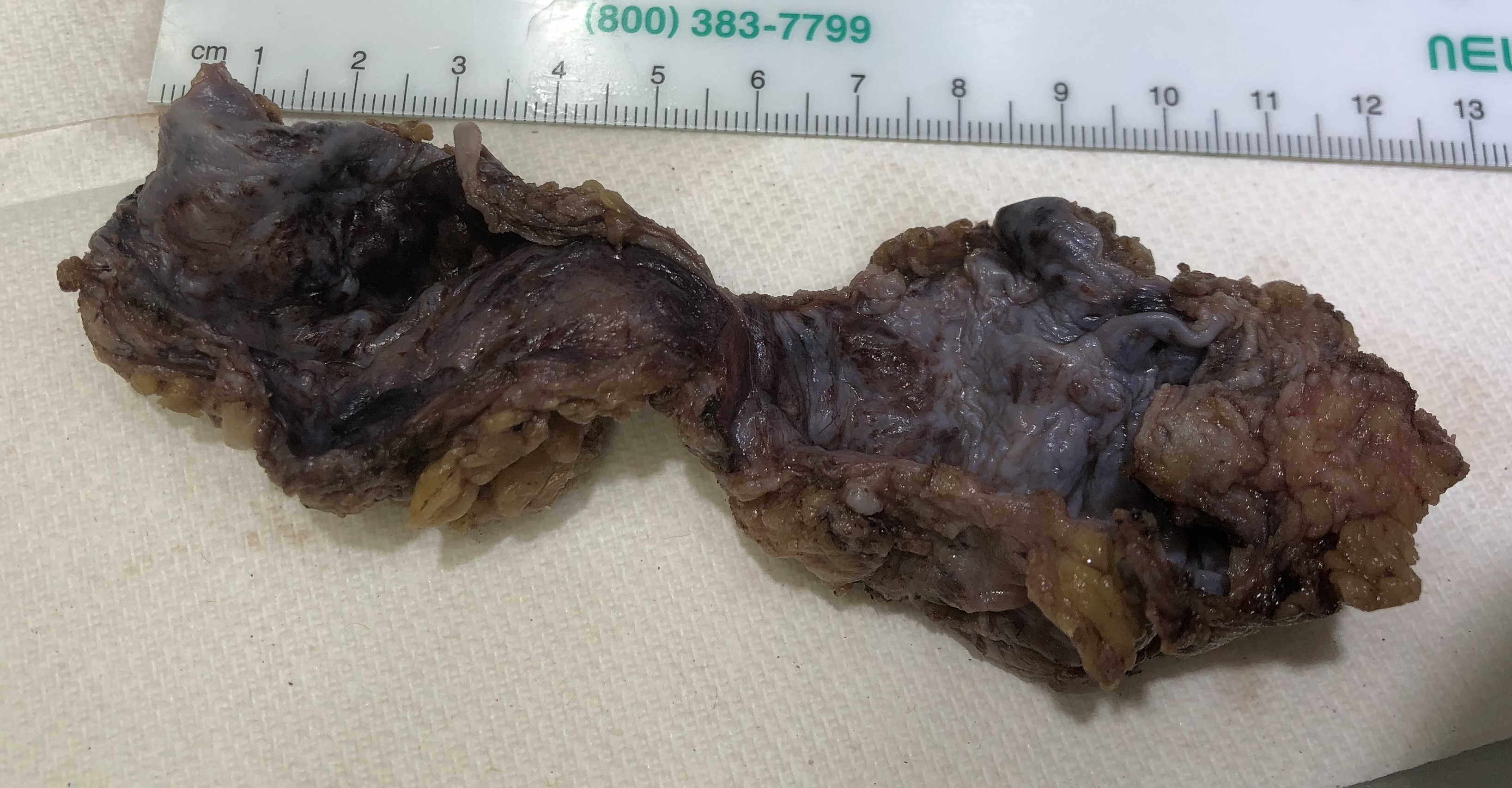
Hernia sac
Author:
Mikael Häggström [note 1]
Comprehensiveness
On this resource, the following formatting is used for comprehensiveness:
- Minimal depth
- (Moderate depth)
- ((Comprehensive))
Fixation
Generally 10% neutral buffered formalin.
Gross processing
A gross inspection is almost always enough, and tissue generally does not need to be submitted except in unique circumstances.[1] ((Still you may submit 1 cassette of one or more representative sections for an inguinal hernia sac in a patient aged up to 16 years of age, or in case of hernia sacs from other regions than inguinal.))
- Gross report
| ((A. Labeled - ___. The specimen is received in formalin and consists of)) __ fragment(s) of pink-tan fibromembranous tissue, measuring ___ cm in greatest dimension and ___ cm in greatest thickness. The surfaces are smooth. There are no sections submitted for microscopic examination. (Representative sections are submitted for microscopic examination in __ cassettes.) |
Microscopic report

In case of a gross only examination, the microscopic report may still be given as a formality:
| Right inguinal region, herniorrhaphy: Hernia sac, gross examination only. |
When microscopy slides of the case are available, you may screen the sample at low magnification to rule out obvious pathology:
| Umbilical hernia sac, hernia repair: Connective tissue lined by mesothelium, consistent with hernia sac. |
Notes
- ↑ For a full list of contributors, see article history. Creators of images are attributed at the image description pages, seen by clicking on the images. See Patholines:Authorship for details.
Main page
References
- ↑ Chesley PM, Black GE, Martin MJ, Johnson EK, Maykel JA, Steele SR (2015). "The utility of pathologic evaluation of adult hernia specimens. ". Am J Surg 209 (5): 783-6; discussion 786. doi:. PMID 25725504. Archived from the original. .
Image sources